
What Is Construction Trackout, and How Do Texas Job Sites Control It?
Trackout is the mud, gravel, and fines that leave a construction site on truck tires and end up on the public street. Under the Texas construction stormwater permit it is a sediment discharge, and it is the first thing a city inspector sees before stepping onto the site. This guide explains what the TXR150000 permit and the four largest Texas cities require, where the three standard controls fail, and how often the exit needs sweeping as a project moves from grading to finish.

What trackout is, and why the inspector looks at it first
Every job site sheds material onto the road that serves it. Haul trucks, concrete mixers, and crew pickups leave with soil packed into tire treads and wheel wells, and drop it on the first fifty to two hundred feet of pavement outside the gate. Traffic then grinds it fine and carries it down the block. The next rain washes what is left into the nearest storm inlet, and from there it travels untreated to a creek, a bayou, or a river. That path is why trackout is treated as pollution rather than untidiness. Sediment is the pollutant the construction stormwater program was written to control, and a muddy street is the most visible evidence that a site’s controls are not working.
There is a practical reason it draws attention first. An inspector can see a tracked street from the truck. A gap in the silt fence or an unprotected inlet takes a site walk to find; a mud trail leads straight to the gate.
What the Texas permit actually requires
Construction stormwater in Texas is regulated by the Texas Commission on Environmental Quality through the Construction General Permit, TXR150000, most recently reissued in 2023. Coverage starts at one acre of disturbance, or any smaller piece of a larger common plan of development. Sites from one acre to under five acres are small construction activities and post a construction site notice; five acres and up are large and file a notice of intent. Both must have a stormwater pollution prevention plan, usually shortened to SWP3 or SWPPP, in place before the ground is disturbed.
The tracking clause
The permit’s language on trackout is short. Part III.F.4 of the permit requires the permittee to minimize, to the extent practicable, the off-site vehicle tracking of sediments and dust, and requires the SWP3 to describe the controls used to do it. Two things follow from that wording. The control has to be written into the plan, not improvised at the gate, and “to the extent practicable” is judged against what a well-run site of the same type would do. A stabilized exit with no sweeping behind it is hard to defend once the street is coated.
Inspection cadence
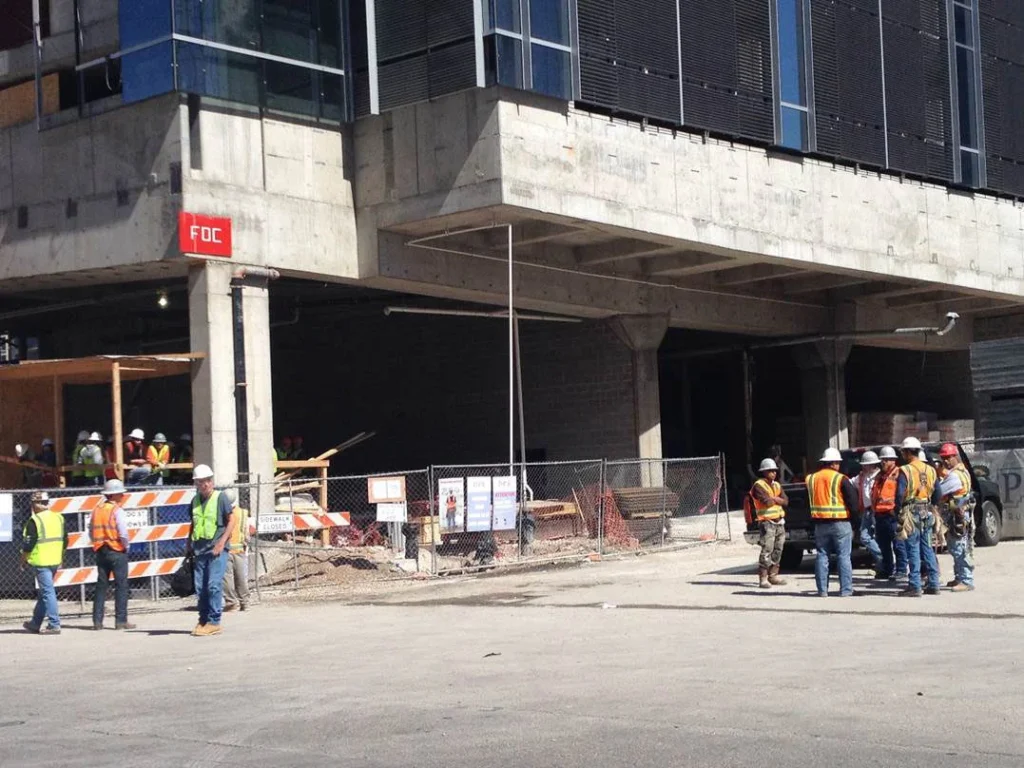
Site inspections under the permit run on one of two schedules: at least once every fourteen calendar days plus within twenty-four hours after a storm of half an inch or more, or a flat once every seven calendar days regardless of rain. Either way, the inspection must cover the locations where vehicles enter or exit the site, checked for evidence of off-site sediment tracking. That line is worth remembering. It is the same thing the city inspector checks, and it means the condition of the gate is documented by the site itself every one to two weeks.
The federal permit sets the standard the state program is measured against. The EPA’s 2022 Construction General Permit requires stabilization at every exit onto a paved road and removal of tracked sediment by the end of the same business day, by sweeping, shoveling, or vacuuming, never by hosing it toward a storm drain. TCEQ’s fact sheet describes its own tracking provision as consistent with the EPA permit, so end-of-day cleanup is the working expectation on Texas sites as well.
| TXR150000 inspections | What it means at the gate |
|---|---|
| Every 7 days, rain or not | The simpler schedule; the exit is on the log weekly |
| Every 14 days, plus within 24 hours of a 0.5 inch storm | Rain restarts the clock, and rain is when the street is worst |
| Every inspection | Entrances and exits checked for evidence of off-site tracking |
What to have ready when the inspector arrives
The SWP3 on site, with the exit and the sweeping plan drawn and described, not just the silt fence.
The inspection log, current, with the entrance and exit line filled in every time.
The exit itself, with stone still visible rather than buried under a crust of mud.
The street outside the gate swept, with the date of the last pass noted.
Sweeping records, which show the plan is being followed rather than just written.
What each city adds on top of the state permit
The four largest Texas metros each hold a municipal separate storm sewer system permit of their own, which obligates the city to inspect construction sites and enforce the controls. The state permit sets the floor. The city is the one that shows up, and the soil under each city decides what the inspector finds.
Austin
Austin’s Development Services Department runs environmental inspections from a pre-construction conference through periodic site visits and a final inspection before the work is signed off. The department’s published list of stop-work violations includes tracking of soil, base materials, gravel, or paving materials onto the roadway. In Austin a tracked street is not a warning item; it is one of the conditions that can halt the job.
Dallas
Dallas requires every construction activity, regardless of size, to comply with Section 19-118 of the city code, and the operator must give the city a copy of the SWPPP. The code’s construction requirements specifically name minimizing the tracking of sediments off site by vehicles and the generation of dust. The city’s construction compliance guide lists street sweeping as a good-housekeeping practice for exactly this purpose.
Houston
Houston inspects every construction site inside the city limits and requires pollution prevention measures to be installed before construction begins. The Houston Permitting Center notes that all inspections are unannounced, and that a copy of the notice of intent or construction site notice has to reach the city at least two days before earth-disturbing activity. On the Gulf Coast clays under most Houston sites, an unannounced visit after a wet week is the scenario to plan for.
San Antonio
In San Antonio, construction stormwater compliance inside the city limits is enforced by the San Antonio Water System. SAWS staff review the SWP3, confirm that controls are located and installed as drawn, and escalate from a field correction note to a stop work order when problems are not fixed. The city’s weekly inspection form carries a line for the entrances and exits, so the condition of the gate is on the record every seven days.
Why soil changes the answer across Texas
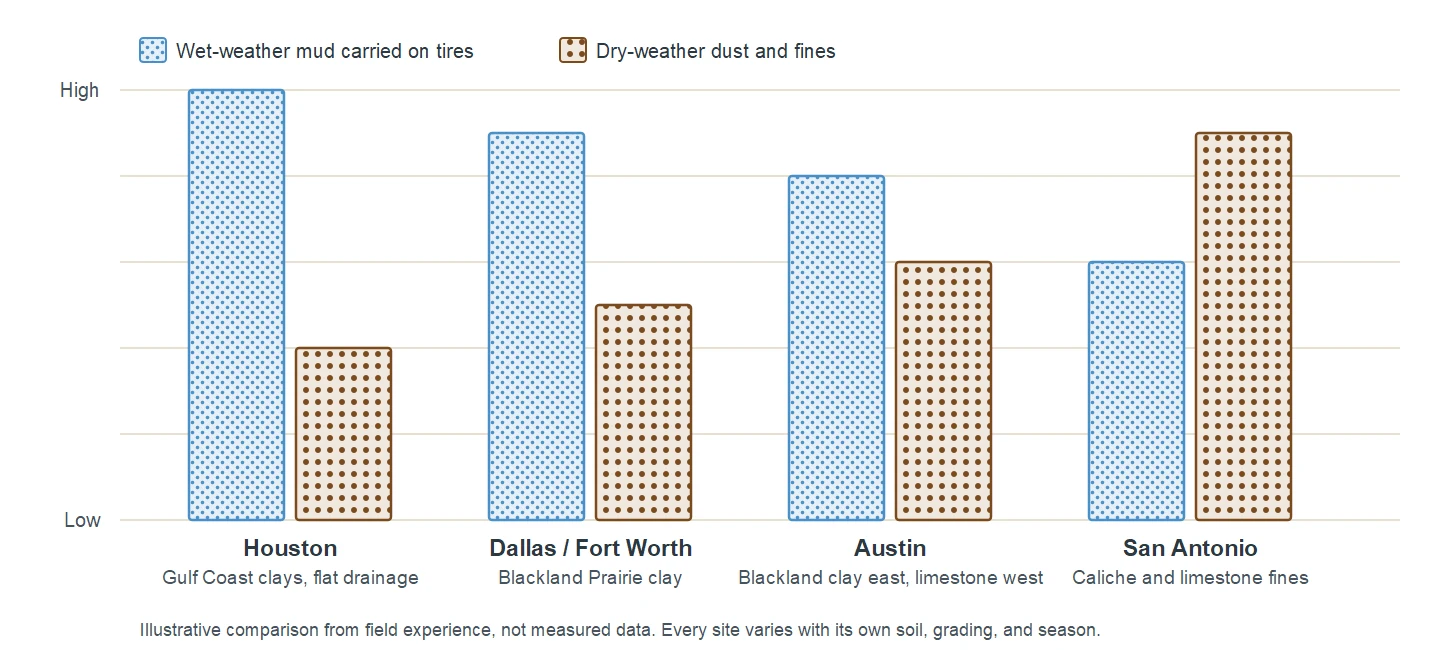
Two sites with the same plan and the same traffic can behave very differently because of what is under them. Houston’s Gulf Coast clays hold water for days on flat ground, so a wet exit stays wet and the tracked material is heavy and sticky; wheel washes earn their keep there. The Blackland Prairie clay under Dallas, Fort Worth, and the east side of Austin is nearly as sticky when wet but shrinks and powders in a dry August, which turns a trackout problem into a dust problem on the same street.
West of the Balcones fault in Austin, and across most of San Antonio, the ground is limestone and caliche: it drains faster and tracks less mud, but the fines it produces are light enough to go airborne, and dry-season sweeping there is as much about dust as about sediment. The chart above shows the pattern in general terms. A control plan written for one soil and copied to a site on another is one of the more common reasons a plan looks complete while the street still fails.
The three controls, and where each one fails
| Control | Where it fails | What fixes it |
|---|---|---|
| Stabilized exit | Stone voids fill with fines; the pad crusts into a smooth ramp | Refresh or extend the stone; add a shaker rack on heavy haul routes |
| Wheel wash | Sump fills, drivers bypass it, the wet apron re-tracks | Clean the sump on a schedule; enforce use; stabilize the apron |
| Sweeping | Delayed until the mud has dried in | Same-day passes; a broom machine for caked material |
Trackout control is one of the few parts of a stormwater plan where the standard practice is settled. The EPA’s track-out control guidance describes the same three tools every Texas plan uses: a stabilized exit, a wheel wash where conditions demand it, and sweeping. What varies from site to site is how quickly each one stops working.
The stabilized exit
A stabilized construction exit is a pad of coarse stone, at least six inches deep, laid over geotextile fabric at every point where vehicles leave the site for a paved road. The stone flexes the tires and knocks loose material off the tread before it reaches the street. TxDOT’s Item 506 makes exits mandatory whenever tracking conditions exist and sets minimum widths of fourteen feet for one-way and twenty feet for two-way traffic, and most city plans follow the same specification. The failure is predictable. Under repeated loads the voids between the stones fill with fines, the surface crusts over, and the pad becomes a smooth ramp that cleans nothing. A pad that has not been refreshed since mass grading is usually the reason a street is dirty in month four.
The wheel wash
A wheel wash or shaker rack adds a second stage for sites where the soil is too sticky for stone alone, which describes most of the clay in Houston and across the Dallas-Fort Worth Blackland Prairie during the wet months. Washes work when the water is contained and the settled sediment is cleaned out; they fail when the sump fills, the discharge runs off the pad, or drivers bypass the station to save two minutes. A wheel wash also creates a wet exit, which is its own trackout source if the apron beyond it is not stabilized.

Sweeping
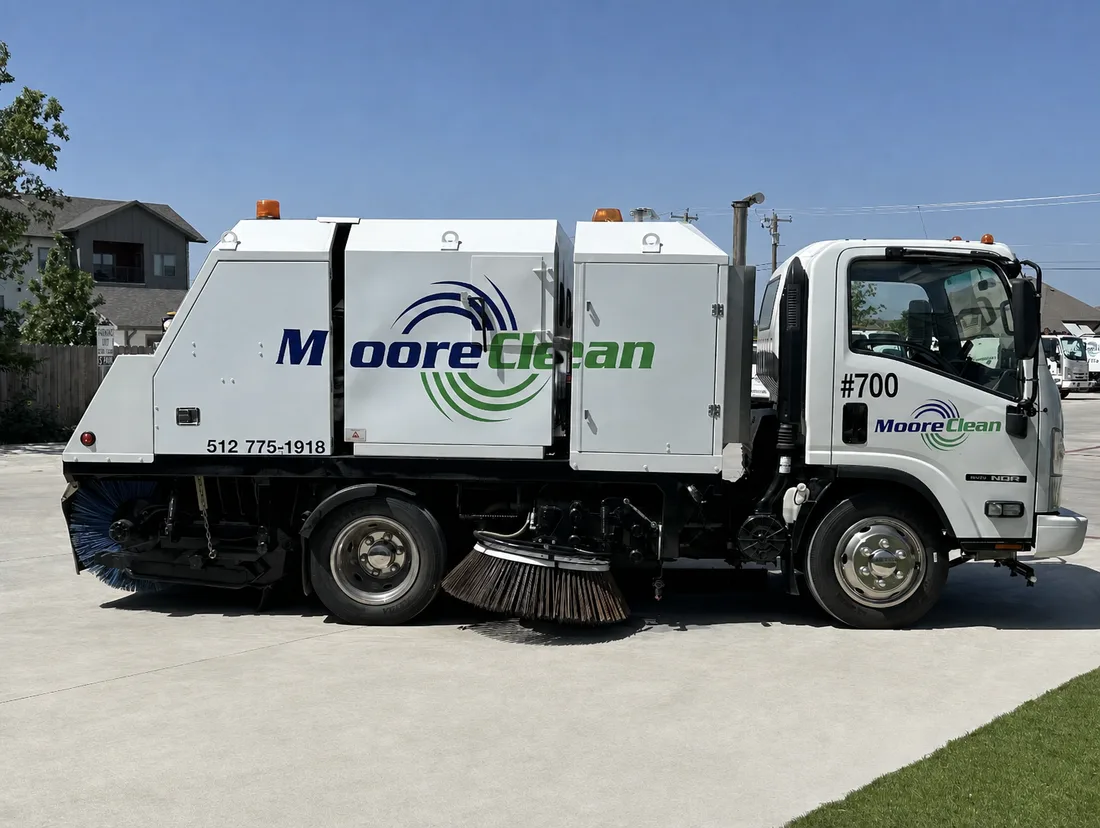
Sweeping is the control that operates on the street rather than on the truck. It is the only one of the three that removes material after it has left the site, which is why the EPA and every Texas city treat it as the required response once tracking has occurred. Its failure mode is timing. Mud swept the same day comes up in one pass; mud left over a weekend is driven into the pavement texture and dried into a crust that a mechanical broom has to scrub off, often with water. The machine matters too. Heavy, wet, and caked material is broom work, and a regenerative air unit built for a retail lot will struggle with it. Our guide to how street sweepers work explains the difference.
How often to sweep the exit, by phase

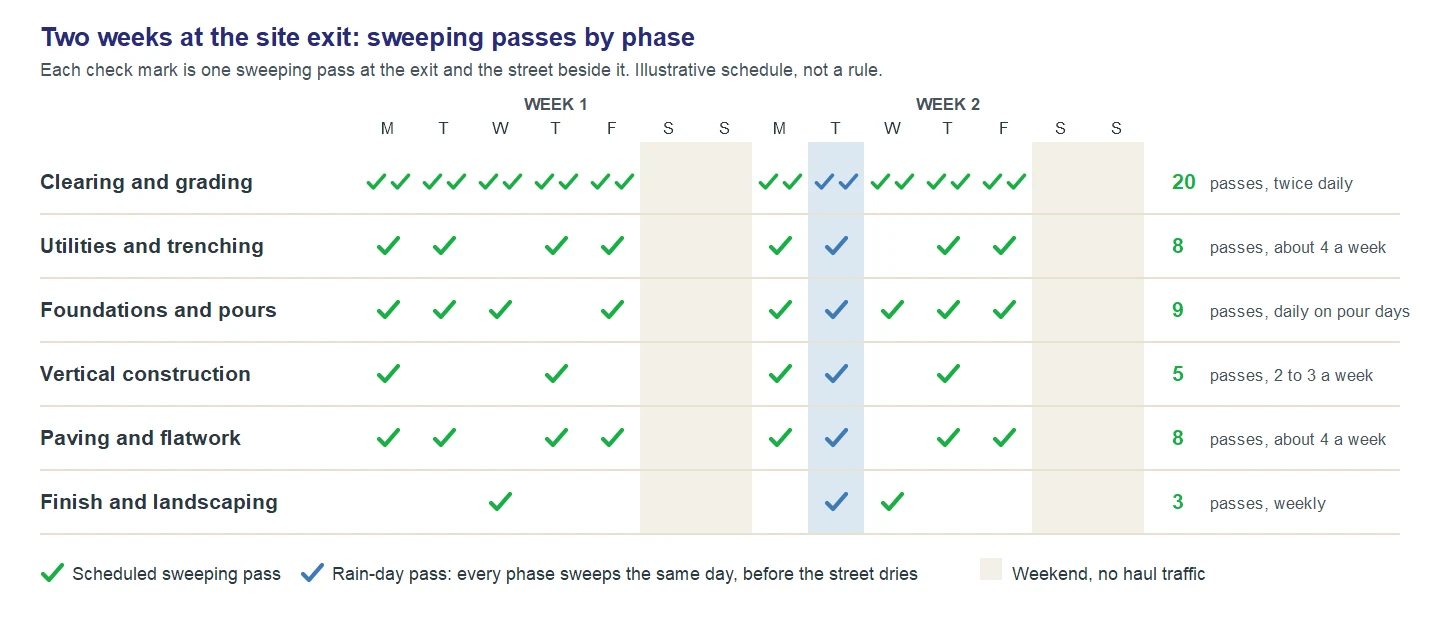
The frequency question has no single answer, because the amount of material leaving a site changes with the work. The schedule board above shows a typical two weeks in each phase across Texas commercial projects. The phase, the weather, and the truck count decide where a given site lands inside it.
Clearing, grubbing, and mass grading are the worst weeks of any project. Every load out is bare soil, the exit is new and often undersized for the haul traffic, and nothing on site is paved. Daily sweeping is the floor, and busy haul days can need a pass at midday and another at close. Utilities and trenching bring spoil piles next to the gate and pump discharge across the exit, so daily to three times a week holds through that phase. Foundations and concrete pours look cleaner but are not: washout, sand, and aggregate from mixers track as readily as mud, and pour days should be treated as haul days. Vertical construction settles down to two or three times a week as the site stabilizes and interior trades take over, then paving and flatwork bring a short return to daily attention while base material and sand are moving. Finish and landscaping carry topsoil and mulch deliveries but little haul traffic, and weekly to every two weeks is usually enough to keep the street presentable and the inspection log clean.
Rain overrides the phase. After any storm that puts the site’s traffic back on wet soil, the street needs sweeping the same day, before it dries and before traffic spreads the material along the block. A rain-day pass is also the one most likely to be on record with the city, since a half-inch storm starts the permit’s own inspection clock.
Getting the exit under control
Trackout is a solvable problem when it is treated as a scheduled service rather than a reaction to a complaint. A written sweeping cadence tied to the phase schedule, adjusted after rain and on heavy haul days, keeps the street clean and produces the paper trail the inspection log needs. Moore Clean provides construction site cleanup and exit sweeping in Austin, Dallas, Houston, and San Antonio, and after more than 25 years on Texas job sites we can usually tell from the exit and the soil what cadence a project needs. Request a quote and we will look at the site, not a chart.
Frequently asked questions
Is trackout a violation if the site is under one acre?
The state permit does not cover a stand-alone site under one acre that is not part of a larger common plan, but city ordinances often do. Dallas applies its construction stormwater rules to every construction activity regardless of size, and most cities can cite a tracked street under right-of-way or nuisance rules. Check the local ordinance before assuming a small site is exempt.
How fast does tracked mud have to be removed?
The federal permit standard is by the end of the same business day, and TCEQ describes its own tracking provision as consistent with it. In practice the safe rule on a Texas site is the same: sweep before the street dries and before the next shift’s traffic arrives.
Can the crew hose the street down instead?
No. Hosing tracked sediment toward a storm inlet moves the pollutant exactly where the permit is designed to keep it out of, and the EPA guidance prohibits it explicitly. Sediment has to be picked up, by sweeping, shoveling, or vacuuming, and returned to the site or disposed of properly.
Does a stabilized exit remove the need for sweeping?
It reduces the load, and on a dry site with light traffic it may keep the street clean for a while. It does not remove the need. Stone pads clog, drivers cut corners, and every rain resets the conditions. Sweeping is the control that handles what the exit misses, and inspectors expect to see both in the plan.
| Source | Content |
|---|---|
| Texas Commission on Environmental Quality | Construction General Permit TXR150000. Coverage thresholds and SWP3 requirement. |
| Texas Commission on Environmental Quality | TXR150000 permit text (PDF). Part III.F tracking clause and inspection schedule. |
| Environmental Protection Agency | Construction track-out controls (PDF). Stabilized exits, wheel washes, sweeping. |
| Environmental Protection Agency | 2022 Construction General Permit. End-of-day removal standard. |
| City of Austin | Environmental inspections. Stop-work violations including roadway tracking. |
| City of Dallas | City Code Sec. 19-118 (PDF). Construction stormwater requirements. |
| City of Houston | Construction inspections. Unannounced inspections, notice timing. |
| San Antonio Water System | Construction compliance. SWP3 review and enforcement. |
| Texas Department of Transportation | Item 506 (PDF). Construction exit requirements and widths. |
| North American Power Sweeper Association | Hiring construction sweeping services. Sweeping as a stormwater best practice. |
Parking Lot Sweeping · Street Sweeping · Construction Site Cleanup · Pressure Washing · Airport Sweeping · Parking Garage Cleaning
Porter Service · Window Cleaning · Graffiti Removal · Debris Removal · Exterior Handyman · Bundled Services