
How Often Should a Commercial Parking Lot Be Swept?
Most commercial parking lots should be swept somewhere between once a day and once a month. Where your property falls in that range depends on what your tenants do, how much traffic the lot carries, what surrounds the pavement, the season, and the standard you want visitors to see. This guide gives you realistic starting cadences by property type, then walks through the factors that should move your schedule up or down.
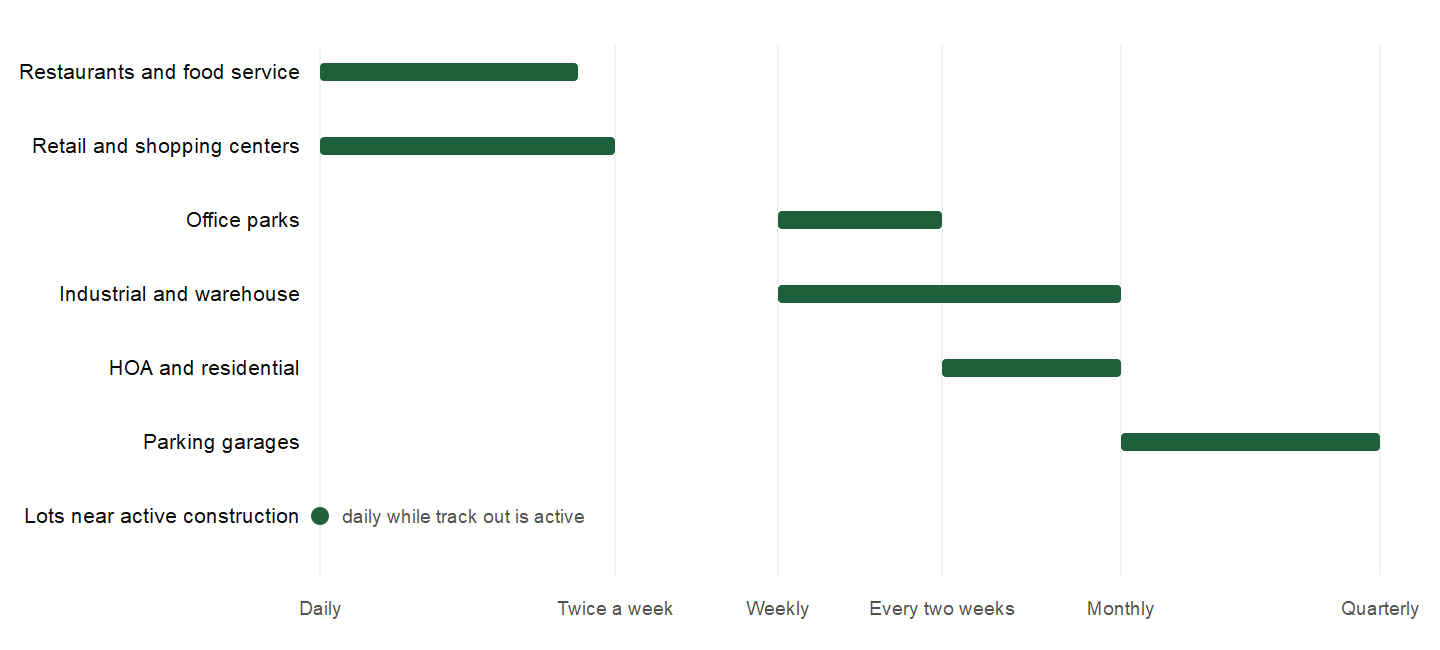
Recommended sweeping frequency by property type
These are starting points drawn from what we see across Texas commercial properties, not rules. Two retail centers a mile apart can need very different schedules. The chart and table give the ranges; the factors that follow are what should move you inside them.
| Property type | Typical cadence | What drives it |
|---|---|---|
| Retail and shopping centers | Two times a week to daily | Customer turnover, carts, food tenants, first impressions |
| Restaurants and food service | Daily to several times a week | Grease tracking, packaging litter, pest prevention |
| Office parks | Weekly to every two weeks | Steady but predictable traffic, appearance standards |
| Industrial and warehouse | Weekly to monthly | Truck track out, gravel migration, dust control |
| HOA and residential developments | Every two weeks to monthly | Leaf and tree debris, street appearance, resident expectations |
| Parking garages | Monthly to quarterly deep sweeps | Enclosed dust buildup, drain protection, tire dust |
| Lots near active construction | Daily during track out periods | Mud and aggregate carried off site, often a permit requirement |
Six factors that should set your sweeping schedule
1. Tenant mix
Food service changes everything. A single restaurant end cap generates more litter, grease film, and pest pressure than the rest of a retail strip combined, and its debris attracts the birds and rodents that generate complaints. Lots anchored by grocery or fast food tenants almost always need the upper end of their range. It is also why the Texas Integrated Pest Management Program at Texas A&M AgriLife makes prevention the core of pest control: remove the food sources and debris first, and most of the problem never arrives.
2. Traffic volume and turnover
A lot that turns over hundreds of stalls a day accumulates litter faster than raw car counts suggest, because every stop is a door opening. High turnover retail needs more frequent attention than an office lot where the same cars sit from eight to five.
3. What surrounds the pavement
Live oaks, pecans, cottonwoods, and open ground feed a lot continuously. Properties with mature landscaping or unpaved edges collect organic debris and migrating gravel even with zero foot traffic. If your lot borders a field, a creek, or a construction site, the schedule that worked last year may not hold.
4. Season and weather
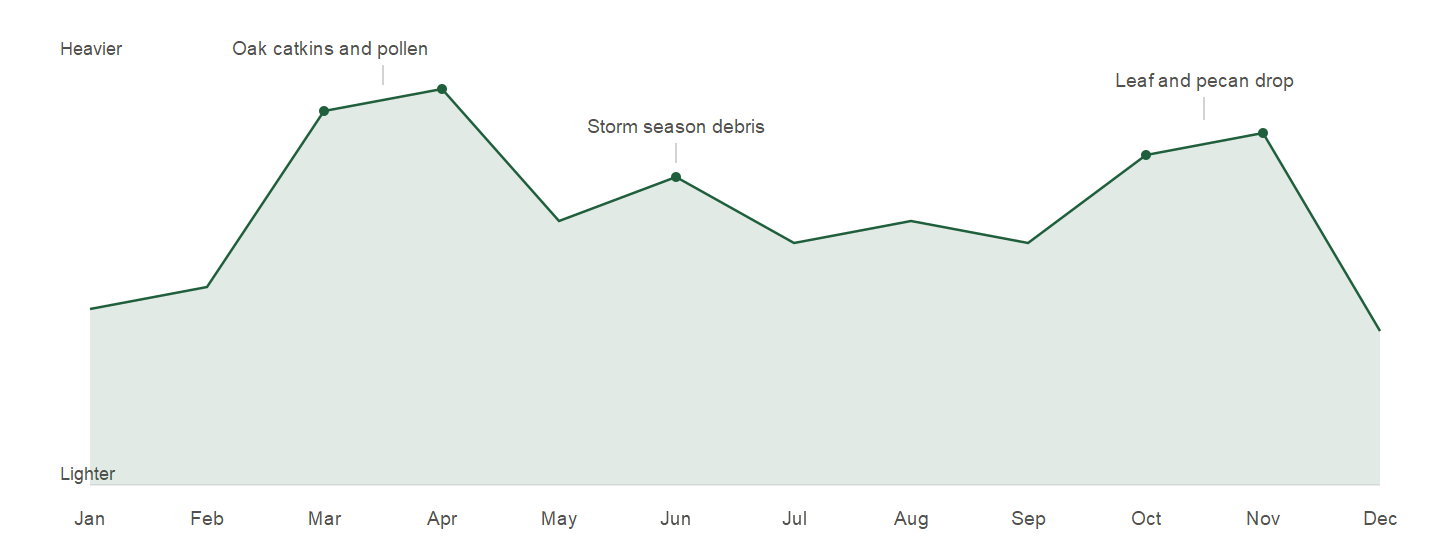
Texas lots do not get a winter break, but the workload shifts through the year. See the seasonal calendar below.
5. Stormwater and compliance obligations
Sweeping is not just cosmetic. The EPA lists parking lot and street cleaning in its national menu of stormwater best management practices because pavement debris is a leading source of the sediment and trash that end up in storm drains. Texas properties covered by a municipal or industrial stormwater permit through the TCEQ stormwater program often have sweeping written into their pollution prevention plan, and sites near active construction can be required to control track out daily. If your property has a stormwater obligation, the schedule is partly set for you.
6. Pavement protection
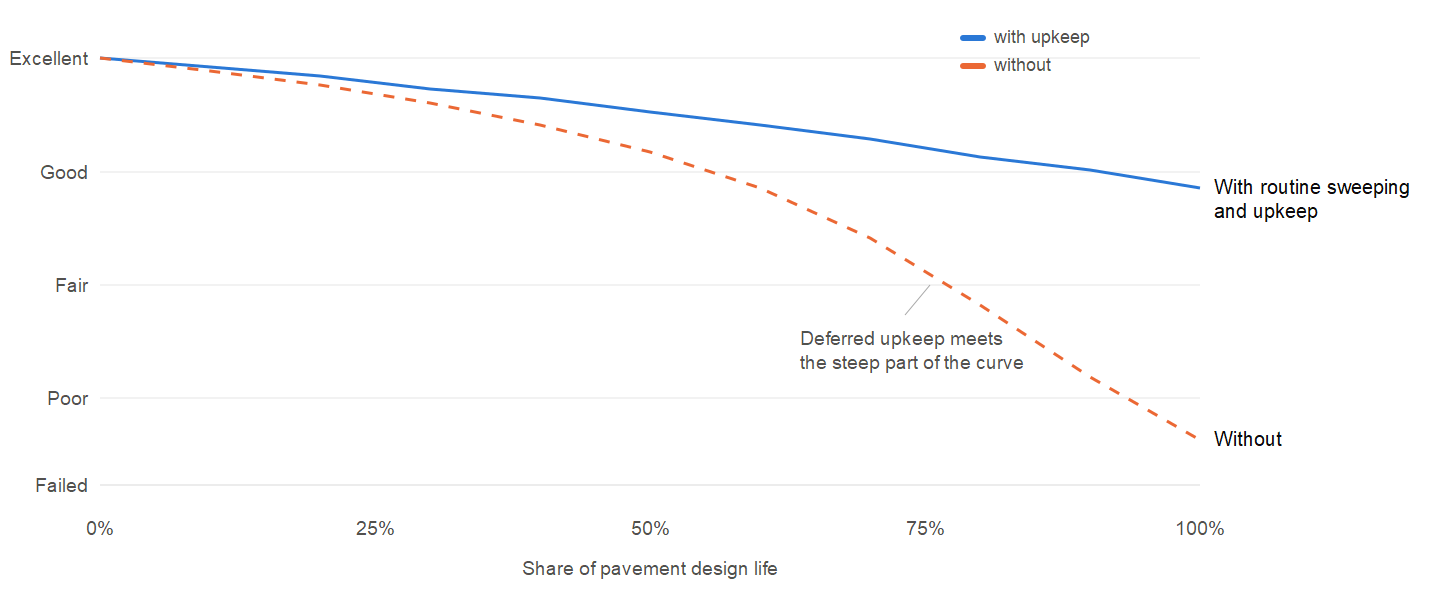
Grit works like sandpaper under tires. It grinds the seal coat, works into cracks, and holds moisture against the surface, which is why pavement preservation programs such as those promoted by the Federal Highway Administration treat routine debris removal as part of extending pavement life. Sweeping on a real schedule is one of the cheapest things you can do to push back an overlay.
Signs your current schedule is not enough
- Litter is visible at the curb line or fence line by the day before the next sweep.
- Storm drains and grates carry a ring of sediment or trapped debris.
- Gravel and grit collect in drive lanes, especially at entrances.
- Birds or rodents are regular visitors near food tenants and dumpster corrals.
- Tenants or residents have started reporting the lot, because by the time they say something, customers noticed first.
Any one of these means the debris load between visits exceeds what the schedule removes. The fix is frequency, not a bigger machine. Grit underfoot is a safety item too: OSHA expects walking surfaces kept clean and free of hazards, and on a commercial lot the sweeping schedule is how that standard gets met.
A Texas seasonal calendar
- Spring: oak catkins and pollen drop hard for several weeks and mat into drains. Most properties need a temporary bump in frequency, especially in Austin and San Antonio.
- Summer: storm season. Wind and heavy rain strip branches and litter across open lots, and debris left after a storm ends up in the storm drain with the next one. Post storm sweeps matter more than the routine cadence.
- Fall: leaf and pecan drop, the longest sustained debris load of the year for properties with mature trees. HOAs and office parks usually step up a level through late fall.
- Winter: the lightest season, and the right time to schedule garage deep sweeps and restriping, including the clearly marked accessible spaces that Texas Accessibility Standards require, while surface debris is at its minimum.
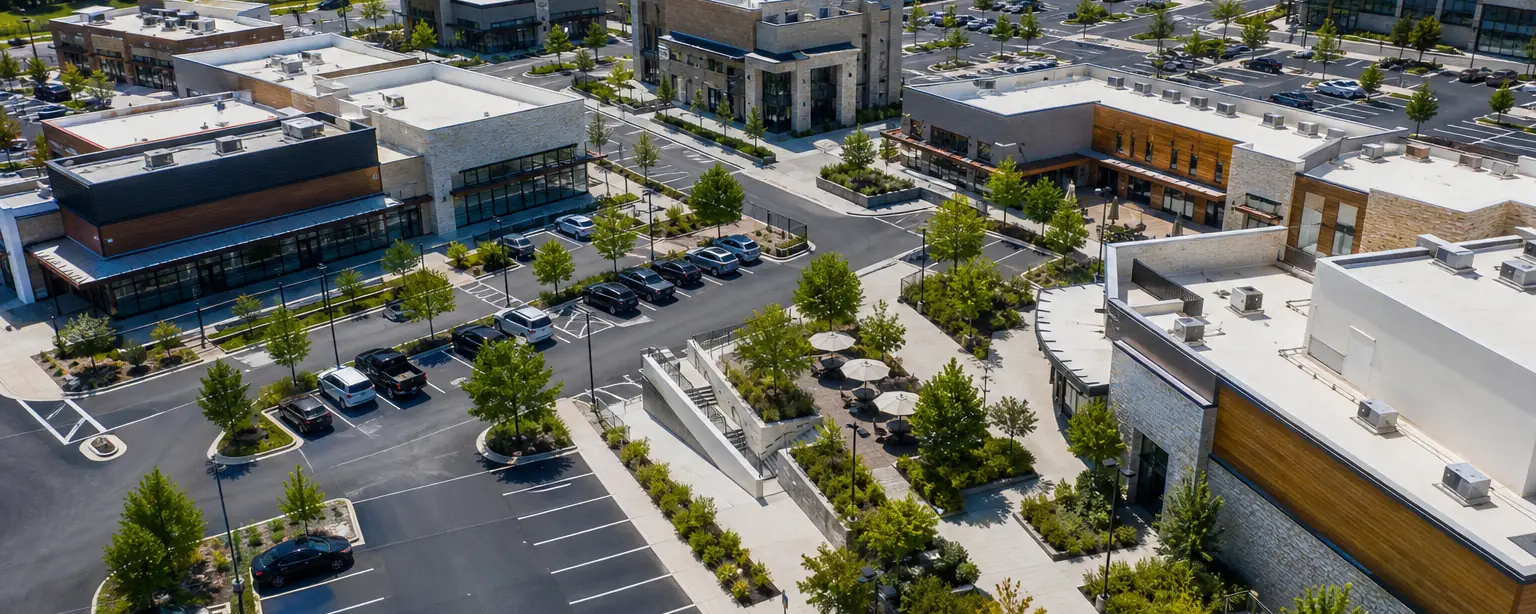
Scheduled sweeping or a day porter?
They solve different problems, and the best run properties use both. Scheduled sweeping removes the accumulated load across the full pavement surface with equipment a person cannot match. A day porter handles what happens between sweeps: the spill at the entrance, the overflowing can, the litter that lands at ten in the morning. High visibility retail typically pairs weekly or better sweeping with day porter service during business hours. If you are choosing only one, sweeping protects the asset and the porter protects the daily impression.
Right sizing your schedule
The honest answer to “how often” is a site assessment: tenant mix, traffic, tree cover, drainage, and any compliance obligations, matched to a cadence you can adjust by season. We provide parking lot sweeping in Austin, San Antonio, Houston, and Dallas, and after more than 25 years of sweeping Texas commercial properties we can usually tell within one walk of the lot what schedule it actually needs. Request a quote and we will look at your property, not a chart.
Frequently asked questions
How often should a retail parking lot be swept?
Most retail centers land between two visits a week and nightly service. Food tenants, cart corrals, and high turnover push toward daily; a small strip with office style tenants can hold appearance at twice a week.
Does the schedule change with the seasons?
In Texas, yes. Spring pollen drop and fall leaf drop usually justify stepping up one level for several weeks, and summer storms call for added post storm sweeps. Winter is the season to scale back and schedule deep work like garage sweeps.
What happens if a lot is swept too rarely?
Debris migrates to the storm drains, grit shortens the life of the seal coat, litter attracts pests, and the property reads as poorly managed. Deferred sweeping does not save money; it moves the cost into pavement repair and tenant turnover.
Is a day porter a substitute for sweeping?
No. A porter keeps the property presentable between sweeps but cannot remove the fine grit and sediment load across acres of pavement. The two services are complements, not substitutes.
| Source | Content |
|---|---|
| Environmental Protection Agency | EPA stormwater BMP menu. Sweeping as a stormwater best practice. |
| Texas A&M AgriLife Extension | Texas IPM Program. Debris removal as pest prevention. |
| Texas Commission on Environmental Quality | TCEQ stormwater program. Texas stormwater permits. |
| Federal Highway Administration | FHWA pavement preservation. Pavement life and upkeep. |
| Occupational Safety and Health Administration | OSHA walking surfaces rule. Slip hazard housekeeping standard. |
| Texas Department of Licensing and Regulation | Texas Accessibility Standards 502 Parking Spaces. Accessible space markings. |
| National Weather Service | National Weather Service. Texas storm season. |
Parking Lot Sweeping · Street Sweeping · Construction Site Cleanup · Pressure Washing · Airport Sweeping · Parking Garage Cleaning
Porter Service · Window Cleaning · Graffiti Removal · Debris Removal · Exterior Handyman · Bundled Services